Are Free Airdrops Dead in 2026? Here’s What Actually Changed
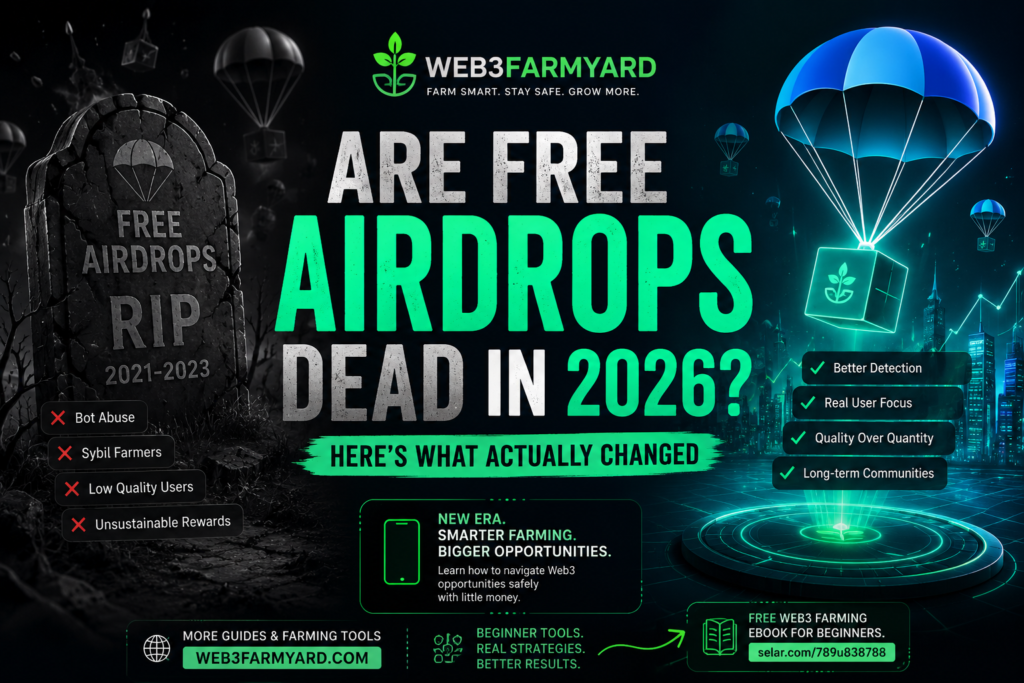
In 2021 and 2022, on crypto Twitter airdrops look like digital rainstorms. People posted screenshots of $15,000 rewards, surprise token allocations, wallets turning into rent money overnight, random Discord grinding sessions becoming life-changing payouts. Then came the flood. Everyone entered. Bots multiplied like mold in a humid basement. Farmers spun up hundreds of wallets. Projects got smarter. Sybil detection evolved. Rewards shrank. Telegram came and half onboarded people into web3 in a bizarre way but all exposure is good exposure, right? And by 2026, one question started echoing across Web3 “Are free airdrops dead?”
Short answer? No.
But the era of easy farming is absolutely over.
The game changed from “spam everything” into something closer to strategic digital prospecting. Less lottery machine. More survival expedition. And honestly, that’s a good thing. Because the people still winning in 2026 are not always the richest. They are the most disciplined, realistic, and consistent.
This article breaks down what actually changed, why most farmers fail today, the mistakes killing beginners, what still works, and how low-capital users can still find real opportunities safely. If you are broke, mobile-only, or starting late, this matters even more.
The Myth
The biggest lie in Web3 farming was this “Just interact early and you’ll get rewarded.” That advice created armies of low-quality farming behavior. People started connecting wallets to everything, signing random transactions, wasting gas, joining fake testnets, farming dead projects, and blindly copying influencers. The result? Most users spent more than they earned. Especially in emerging markets where even $1 in gas fees matters.
I learned this the hard way .
I remember spending days interacting with protocols across multiple chains after seeing threads on X. Bridges. Swaps. Liquidity pools. Random governance votes. Endless check-ins. content creations. Transaction volumes for testnets were through the roof, i was spamming transaction counts. My wallet activity looked impressive. But my profits looked like abandoned shopping carts. One project rugged, another never launched. Another excluded obvious farmers, another rewarded only high-end users that added real money. One vanished entirely. Another only rewarded discord users. Only one protocol rewarded me at the time and it was not up to $100
That was the moment many I realized something important, activity alone is no longer enough. Projects now want real users, believable behavior, ecosystem participation, retention and reputation. Not just transaction spam.
What Actually Changed in 2026
1. Projects Became Anti-Farmer
Early airdrops rewarded almost everyone. Now projects actively hunt low-quality farming patterns. Modern detection systems track:
- wallet clustering,
- repetitive behaviors,
- suspicious timing,
- copy-paste interaction flows,
- bridge loops,
- gas patterns,
- wallet age,
- ecosystem depth.
If ten wallets all perform the same actions in the same order within similar timeframes, they all show farming behaviours. Projects learned from billions lost to opportunistic farming. Now they reward users who look human.
2. Quality Became More Important Than Quantity
In 2023: “Do everything.”
In 2026: “Do meaningful things consistently.”
This is the biggest shift. Instead of touching 100 random protocols once, many successful farmers now choose smaller ecosystems, it helps maintain a more consistent strategy. They stay active longer, participate socially, use governance when available, provide feedback, and maintain realistic usage patterns. Think of today’s farming like building reputation.
The protocols no longer care how many times you entered the gate. They care whether you became part of the ecosystem.
3. Capital Efficiency Matters More Than Ever
Big wallets still dominate some ecosystems.That part is true but many projects realized whales distort communities. For instance during the fastprotocol.io miles campaign where you earn miles for swapping on the fast RPC a user topped the leaderboard by doing a total number of 16 swaps with a total of $16M in volume. Throughout the campaign, his volume and swap number has stayed the same and he is still topping the leaderboard. So ecosystems increasingly reward consistency, retention, social participation, testing behavior, educational contribution, feedback quality, and real usage. This opened doors for low-capital users again especially low capital users in developing regions. You do not always need $5,000 anymore.
Sometimes you need patience, organization, timing, and clean wallet habits.
The Biggest Mistake New Farmers Make
Chasing Every “Potential Airdrop”
This kills more wallets than scams. The farming landscape today is full of fake alpha threads, engagement farming influencers, recycled rumors, imaginary “confirmed” airdrops. Some accounts make money from impressions, not farming accuracy. So they flood timelines with:
“NEW AIRDROP”
“DON’T MISS THIS”
“FREE MONEY”
“100X GAINS”
Meanwhile the actual project may never launch, never reward, or intentionally exclude obvious farmers. Your attention becomes the product. Your gas fees become the sacrifice.
What Is The Realistic Farming Strategy That Still Works?
This is where things become practical especially if you have little money.
Step 1: Choose Small Ecosystems Early
Large ecosystems become overcrowded quickly. Instead of farming only well known popular and over diluted projects, look for:
- smaller infrastructure projects,
- emerging ecosystems,
- niche tooling platforms,
- experimental networks,
- community-driven protocols.
Smaller ecosystems often reward early contributors more generously because competition is lower, engagement matters more, communities are smaller, retention is easier to track.
Step 2: Build Daily Interaction Systems
As a farmers do not rely on memory, build routines. Example:
Morning Check
- Open farming dashboard/List (you should have a list of all the protocols you farm)
- Check Discord announcements
- Review X notifications
- Verify ongoing campaigns
- check and complete social tasks
Daily Tasks
- 3 swaps
- 3 bridges
- Ecosystem check-ins
- Social engagements
Weekly Tasks
- Test new features
- Join AMAs
- Submit feedback
- Explore ecosystem partners
This structure matters because farming success often comes from small repeated signals over time. Not giant one-day bursts.
Ranking the Best Types of Airdrop Opportunities in 2026
1. Testnets
Still king for low-capital users. Why?
Because many testnets require little money, reward consistency, value feedback, encourage experimentation. The key difference now projects monitor quality more carefully. Mindless clicking is easier to detect.
2. Ecosystem Loyalty Campaigns
Projects increasingly reward long-term users, active community members, repeated engagement. This benefits disciplined small farmers enormously especially users who can maintain lightweight daily activity. When for instance you hold an NFT airdropped to you at the beginning of a campaign and didn’t jeet, you get rewards for holding, plus perks from other partner ecosystem plus perks in the discord channels if you are also an active user
3. Governance Participation
Voting matters more now. Projects want users involved in ecosystem decisions. Even small participation helps create believable wallet behavior. This was seen with Berachain DAO seats for certain holders. and also in Zetarium dex campaign where they allowed users to claim the ZET governance token to allow them participate in resolving predictions and governing decisions
4. Social Reputation Farming
This area exploded in 2026. Projects now track Discord participation, educational content, feedback quality, bug reports, community activity.
Your reputation increasingly matters alongside your wallet.
5. Ambassador Programs
A Web3 ambassador program is when a crypto project recruits community members to help grow its ecosystem. Instead of rewarding only wallet activity, projects now reward people for:
- promoting ecosystems,
- helping communities,
- onboarding users,
- creating content,
- testing products,
- moderating discussions,
- and increasing awareness.
Think of ambassadors as part community member, part ecosystem builder, part early supporter. And in return, projects often reward them with:
- tokens,
- NFTs,
- whitelist access,
- governance privileges,
- stablecoin rewards,
- ecosystem allocations,
- or future airdrops.
The Security Problem Nobody Warns Beginners About
As farming became popular, scams evolved into industrial crime. Modern drainers are terrifyingly convincing. Some fake sites now perfectly mimic wallet interfaces,transaction prompts, Discord verification systems, bridge confirmations. And mobile users are especially vulnerable because smaller screens hide details.
Golden Rule
Never rush transactions these scammers weaponize urgency. If a site or an NFT says “limited claim,” “claim expires soon,” “wallet verification needed,” “sync wallet now,” slow down immediately. Fear and greed are the twin fishing hooks of Web3 scams. Sometimes you get an NFT that says you have won something or a token for an airdrop you didn’t interact with. A sudden spike in your account balance caused by a token you didn’t know its origin.
Read more about wallet security here and learn to spot scam projects here
My Recommendation for Low-Capital Farmers
If you have very little money, focus on:
1. Consistency Over Scale
Ten dollars used intelligently for months beats reckless farming bursts.
2. Ecosystem Depth
Go deeper instead of wider. Understand projects properly. Use them naturally. Become recognizable inside ecosystems. Contribute where you can. If you have observations, say it out in the community, let your tiny voice be heard from time to time
3. Safety First
A single wallet drain can erase months of effort. Use burner wallets, wallet separation, approval revoking, secure backups. Always. Read transactions in new ecosystem before you sign them
The Psychological Trap of Farming
Nobody talks enough about this part. Airdrop farming can become emotionally exhausting. You see others posting wins, screenshots, easy money stories, sudden token pumps. Meanwhile your own rewards may feel tiny or nonexistent. This creates dangerous pressure over farming, reckless spending, emotional trading, scam vulnerability. Remember social media shows harvests, not failed crops. Many screenshot posts hide months of losses, failed farms, hidden capital, insider advantages. Do not compare your beginning to someone else’s (edited) highlight.
So Are Free Airdrops Really Dead?
No. But “free” changed definition.
In 2021: free meant random rewards for early clicks.
In 2026: free means attention, consistency, learning, reputation, patience, risk management. The cost is no longer just money it is now discipline. And honestly? That makes the ecosystem healthier because now smaller, smarter, realistic farmers can still compete. Not by brute force, fake volume nor by wallet spam. But by staying early, staying safe, staying organized, and acting like real users.
Other articles that you might be interested in:
How I Started farming Airdrops with $0
How to Position for Airdrops in 2026
Why most web3 Farmers are broke
Looking for Airdrops to join?
Check here for free airdrops Are you new to web3 and airdrops?
Get free beginner friendly onboarding experience. Master web3 interactions in 7 simple steps